
Understanding changing feeding patterns
Read a feeding history with more confidence, without turning every change into a conclusion.
The essentials
- Compare complete periods with similar recording habits.
- Bottle volume and breastfeeding time describe different things.
- A chart is a useful starting point for a conversation, not a feeding assessment.
Start with what was actually recorded
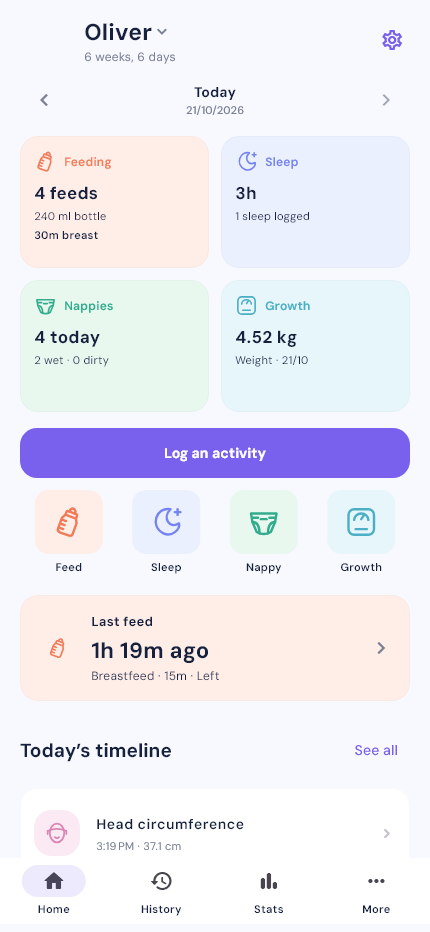
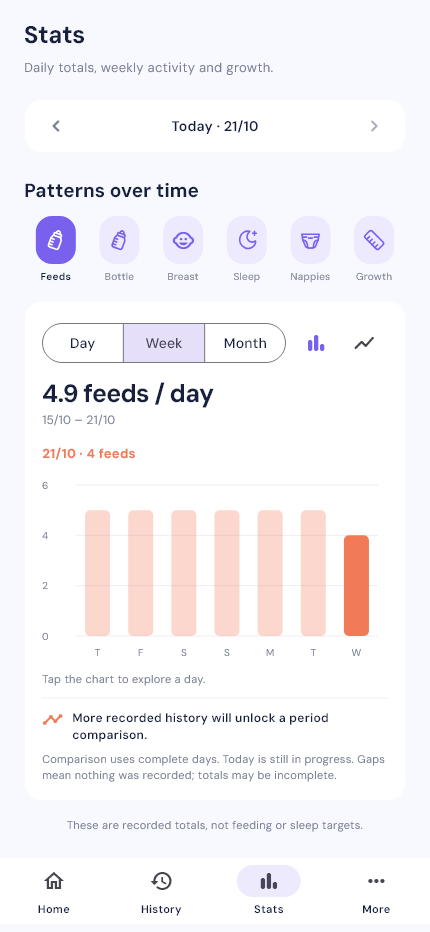
Before interpreting a rise or dip, check the underlying entries. Was a bottle saved twice? Did someone forget to stop a timer? Was yesterday fully logged while today is still in progress? A total measures the record you have, which may be different from all the care that happened.
Try selecting two completed days or two completed weeks. Use the same type of measurement in each period and make a note of known gaps. This simple check often explains a surprising chart without needing to change a feeding routine.
Understand the difference between duration and volume
Bottle volume tells you how much milk was recorded as consumed. Breastfeeding duration tells you how long the recorded session lasted, after any pauses you excluded. Feed count tells you how many entries there are. None is a substitute for the others.
For example, a mixed-feeding day might show four bottles and several breastfeeds. Adding breastfeeding minutes to the bottle's millilitres would create a number with no useful meaning. Keep the categories separate so you can ask a clear question about the part of the record that changed.
Put busy feeding periods in context
Some babies have periods when they want several feeds close together. This is often called cluster feeding. A cluster can look striking in a timeline because the entries sit close together, but spacing alone does not show the amount of milk received or establish that something is wrong.
If a period feels different, write down what you noticed rather than assigning a cause. ‘Asked to feed several times this evening’ is more useful than guessing at supply, reflux or a growth spurt. Your healthcare team can help interpret the change in the context of your baby.
Further guidance: Pregnancy, Birth and Baby: Breastfeeding your baby
Look beyond a single number
Feeding assessment considers a bigger picture, including feeding effectiveness, wet nappies and growth. During breastfeeding, swallowing and how attachment feels may be useful observations to discuss. The appropriate interpretation depends on age and individual circumstances, not only an app average.
Keep your questions specific: ‘These feeds seem harder to finish’, ‘I am worried about attachment’ or ‘The wet nappies seem different’. A note about what concerns you helps someone understand why you are asking, even if your log has missing entries.
Further guidance: NHS: Is my baby getting enough milk?
Make a comparison you can explain
Suppose a completed week contains 28 bottle entries and the next contains 21. That is a change in recorded bottle count, not automatically a reduction in overall milk intake. There may be different bottle sizes, more breastfeeds, a missed day or a second caregiver who logged inconsistently.
Review a few actual entries before relying on the headline. If you export a weekly or monthly summary, keep the original records available as well. A summary is easier to read, while individual entries explain what sits behind it.
Know when to stop analysing and ask
If your baby is feeding less than usual, has noticeably drier nappies or seems unusually sleepy or unwell, seek medical advice promptly. Difficulty breathing or being unable to wake your baby needs emergency help through your local emergency service. Do not wait for another entry to confirm that a graph is changing.
For less urgent questions, bring the record to your midwife, child health nurse or doctor and explain what you have observed. You do not need a diagnosis, a perfect chart or a full week of data to ask for help.
Further guidance: NHS Wales: Signs of illness in babies
Sources & further reading
For the full guidance and advice for your circumstances, start with your local healthcare team and these resources.
NHS: Is my baby getting enough milk?Pregnancy, Birth and Baby: Breastfeeding your babyNHS Wales: Signs of illness in babiesGeneral information only. This site and app do not diagnose, treat or monitor medical conditions. If your baby seems unwell, seek medical advice rather than waiting to collect more records.
A little more to explore

Breastfeeding: finding your rhythm
Recognising feeding cues, getting comfortable and knowing what is worth recording.
Read guideBottle feeding, one feed at a time
Responsive feeding, safe preparation and a clear record of the milk your baby actually takes.
Read guide