
Naps, night waking and the bigger picture
Make useful comparisons, handle interrupted timers and understand the limits of a sleep graph.
The essentials
- Count actual recorded sleep, excluding awake pauses.
- Compare completed days and check for gaps or overlapping entries.
- A changing pattern deserves context rather than a parenting score.
Waking is part of the picture
Sleep changes as babies develop, and waking during the night can continue beyond the newborn period. Different families also use ‘sleeping through’ to mean different things. A timeline is more useful when it shows the times you recorded instead of trying to label a night as successful or unsuccessful.
Try beginning with a simple question: are you trying to remember the last nap, describe a change to a nurse or coordinate care overnight? The question determines which details are worth collecting. You do not need to measure everything because a chart has room for it.
Further guidance: Raising Children Network: Sleep needs and patterns
Use one consistent way to handle interruptions
If a sleep starts at 10:00 and ends at 11:15, the elapsed period is 75 minutes. If your baby was awake for a ten-minute interruption that you paused out, the recorded sleep is 65 minutes. Both the start and finish time and the excluded pause help explain that total.
In Baby Tracker, paused timer time does not contribute to the sleep duration. Agree with other caregivers when to pause versus finish a sleep, so tomorrow's record describes things in much the same way as today's. There is no need to manufacture exact times you did not observe.
Compare complete days, not a morning with an evening
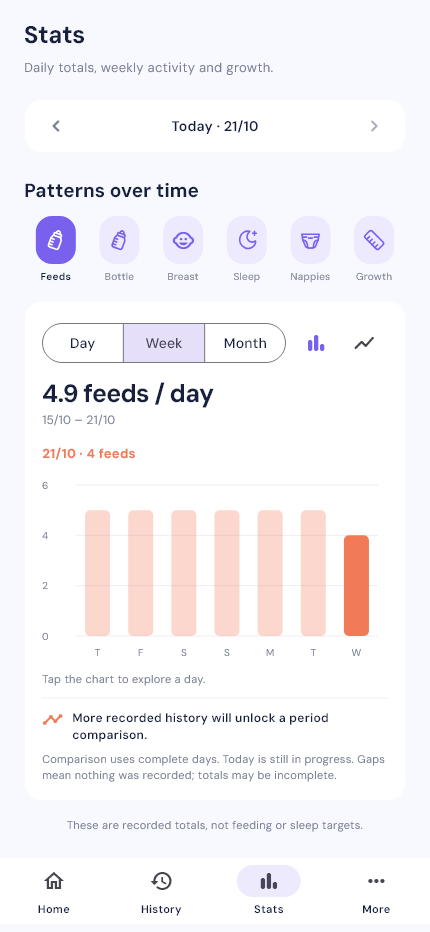
At lunchtime, today's total has many hours left to accumulate. Comparing it with yesterday's finished total can make an ordinary day look unusually short. The same applies to a week that is only partly finished.
Choose completed periods and check the entries behind them. Look for an overnight timer left running, a duplicated nap or an afternoon with no entries. A gap means the record is incomplete; it does not prove your baby stayed awake. When you know a day was only partly logged, keep that context in a note.
Use notes for context you will otherwise forget
You do not need a story attached to every nap. A few specific words are useful when something would be confusing later: ‘timer ended late’, ‘nap with grandad; approximate start’ or ‘travel day; afternoon not logged’. Observations like these help distinguish a change in sleep from a change in recording.
When sharing care, check that another person has not already entered the same sleep. If you find a duplicate, correct the original records instead of trying to compensate by shortening a later nap. That keeps the daily summary easier to explain.
Look for cues as well as patterns
A graph describes what happened earlier. It cannot see your baby's tired signs now. Looking away, yawning or a change in behaviour may be cues to reduce stimulation and offer settling. Consider other needs too; crying alone does not tell you whether a baby is hungry, tired or uncomfortable.
If you try a small change to your routine, write down what you actually changed and how it felt. A longer nap afterwards does not prove the change caused it. Repeated observations and a conversation with your healthcare team are more useful than one unusually good afternoon.
Further guidance: Raising Children Network: Tired signs
Turn a history into a useful conversation
For an appointment, pick a representative week rather than the best or worst night. Explain which days were fully recorded and what concern brought you there. ‘Settling has become much harder this week’ is a clearer starting point than ‘the average is wrong’.
If tracking increases anxiety, reduce it to the details you actually need or stop for a while. The purpose of a record is to support your family. Seek professional help when sleep or exhaustion worries you; you do not need an unusual statistic to justify asking.
Sources & further reading
For the full guidance and advice for your circumstances, start with your local healthcare team and these resources.
Raising Children Network: Sleep needs and patternsRaising Children Network: Tired signsGeneral information only. This site and app do not diagnose, treat or monitor medical conditions. If your baby seems unwell, seek medical advice rather than waiting to collect more records.
A little more to explore

Newborn sleep: small stretches, changing days
Get to know newborn sleep, recognise tired cues and keep a record that helps rather than adds pressure.
Read guideA simple starting point for safer sleep
Prepare a clear sleep space, plan for tired nights and make sure every caregiver knows the same basics.
Read guide